Public Outreach
AECOM Burlington has established a series of public-engagement goals that will define success for any cultural resource project. AECOM goes beyond typical noteworthy public-outreach components and provides a sustainable public-engagement program that reaches out to the citizens around project areas and beyond during all phases of projects, and for decades after project completion. All public-outreach tasks are coordinated with agencies and stakeholders.
Chart 1. Public-Engagement Goals and Positive Outcomes
| Public-Engagement Goals | Positive Outcomes | ||
| High School Lesson Plan | ● Sustainable
● Enlivens history in the classroom ● Develops close partnerships with other institutions ● Promotes history events and clubs |
||
| High School Student Participation | ● Experiencing entire project process (plans to report)
● Helps students be active historical researchers ● Hands-on activities ● Keeping it fun ● Offers opportunities for students to showcase their talents |
||
| Community Web Site Interface | ● Clarify public perception
● Continuous feedback ● Heritage education ● Encourages oral and local histories |
||
| Self-Guided Walking Path and Signage | ● ADA compliant
● Interaction with education exhibits ● Disseminates information ● Paterson-based company design |
||
| Site Brochures | ● Mass appeal
● Directional/informational ● Paterson-based company design |
||
| Popular Booklets | ● Source document for high school lesson plan
● Input from all parties ● Readable to the general public |
||
| Public Museum Displays | ● Source document for high school lesson plan
● Opportunities for students to showcase their talents ● Public-private partnerships |
High School Lesson Plan
AECOM can develop high school history lesson plans that follow the curriculum framework of any state school district guidelines. History department heads help determine how best to fit the history lesson plans into classes currently taught at their high schools. One advantage to this community-outreach approach is that the project’s technical documentation is provided as a resource support to the lesson plans and it is sustainable. In this way, technical documents normally not given a wide public audience are shared continuously with the public through students and teachers.
AECOM implemented this type of public-outreach plan at Passaic High School as part of the New Jersey Department of Transportation’s Route 21 project. The title of the Passaic history lesson plan, which followed the New Jersey Department of Education Guidelines, is Historic Passaic, Industrial America and the Era of World War (1870–1945) and the Modern Age (–Present). The history lesson plan fits within the subjects of American history and New Jersey history for grade levels 9–12. The purpose of the history lesson plan is multifaceted. It is intended to give students an enhanced awareness and greater appreciation of the history of Passaic. Topics include immigration, ethnicity, industry, and economics, and are aimed to provide students with a comprehensive introduction to the origin of their surroundings. Students are able to develop an ability to see changes in the built environment as a continuing process connected by the experiences of generations who lived and worked in these same places.
High School Student Participation
AECOM can coordinate with high schools to help build a team of students to mirror the project from start to finish. The students have the opportunity to understand project planning, followed by site visits, lab visits, and reporting. For a New Jersey Department of Transportation project at Raritan Landing (an eighteenth-century town), AECOM worked with a group of students from a Middlesex County High School, where they developed a videotape of the project. The video is entitled Uncovering Truths: Raritan Landing.
Community Web Site Interface
AECOM can create a method by which we will contact the local and descendant community (e.g., religious, social, and fraternal orders; education; museum displays; etc.) via the Internet (www.ushistory.org) and solicit their input for research designs, as well as maintain an active archive of all responses. The web site would represent the voice of the community and record the interested public’s varied viewpoints during the physical excavation of a project site. Specifically, AECOM will ask descendant communities what they want to know about an archaeological investigations and how such investigations will assist in reclaiming their lost cultural heritage. Their responses will help to dissolve the differing perceptions between their present and the past, and will be included in the research design whenever possible.
Self-Guided Walking Path and Signage
AECOM can develop self-guided walking paths and signage to offer members of the public a view of ongoing archaeological excavations and to interpret such activities for visitors. The placement and configuration of such walking paths can be designed to meet accessibility guidelines for the mobility impaired. Directional signs or banners for mounting on the construction fencing can be installed as needed throughout a project area. This signage would also be designed to identify the various archaeological site locations and direct visitors to key observation points. These interpretive sign elements would be installed prior to the commencement of excavations, and would consist of color and monochrome images, maps, and text that explains, in non-technical language, the goals of the project, the methodology being employed, and a summary of the site’s background history. At the key observation points, an archaeologist would be periodically available to explain the excavation process and answer questions regarding the excavations. A site brochure (noted below) would be linked to the self-guided walking path.
Site Brochure
Site brochures can be created and used hand-in-hand with self-guided walking tours. An all-weather fabrication and mounting method to hold brochures can be constructed at entry points of self-guided walking tours. The interpretive elements of the brochure would include color and monochrome images, maps, and non-technical text explaining the project goals, the methodology employed, and a summary of the site’s background history in plain language. The brochure can be designed to identify both standing structures and archaeological site features.
Popular Booklet
A major concern in the field of cultural resource management is that site reports, particularly on large technical efforts, are produced primarily for professionals—those working in related technical disciplines and the individuals within the state and federal agencies responsible for reviewing the investigations described in such reports. Very rarely do such reports reach the public, and if they do, they are incomprehensible to the general public due to their structure, content, and language. In addition, the research focus of the sites described in these reports is primarily of interest only to archaeologists, anthropologists, and, possibly, historians. These reports rarely provide information about the past that is understandable and interesting to the public. This is a particularly troubling problem in compliance archaeology, given that a stated purpose of legislation governing these cultural resource efforts is to preserve and document these sites for the public benefit.
AECOM can develop narrative type booklets for project sites, in addition to the normal technical reports written for compliance. What makes such narratives possible is the existence of parallel historical data in the documentary record. Undoubtedly, an archaeological/historical narrative is more interesting and understandable to the public than the “successful” testing of hypotheses. “Theoretical” discussions will be left as part of technical reports. In addition, these booklets can describe the nature of the archaeological investigation within the site and the community involvement.
This approach is along the lines of historic ethnography, which consists of histories that are basically narratives of events, individuals, and/or communities. What is happening in the larger society is described and explained through the study of these events, individuals, and communities. This approach to developing archaeological/historical narratives for sites has become an issue of growing interest within the historical archaeology professional community. This shift in emphasis within historical archaeology reflects current trends in history, where historical evidence is used as the foundation upon which narratives are built. The narratives in these popular booklets are supported throughout by extensive and detailed primary and secondary historical research. What specific narratives get developed will be based on the nature and extent of the intact historic-period assemblages, deposits, features, and structures examined during the research program. By using this approach, historical personages and events can be introduced and reintroduced in recurring fashion throughout the booklet, all linked to different features throughout the archaeological site.
Public Display
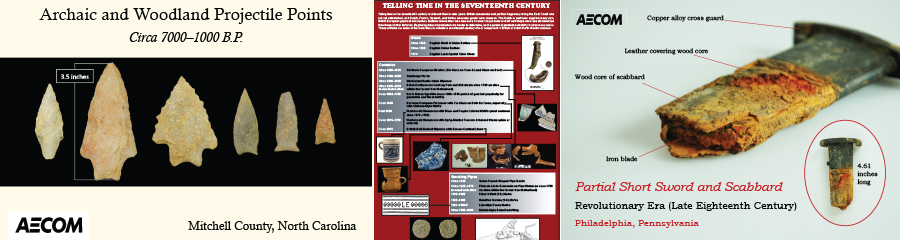
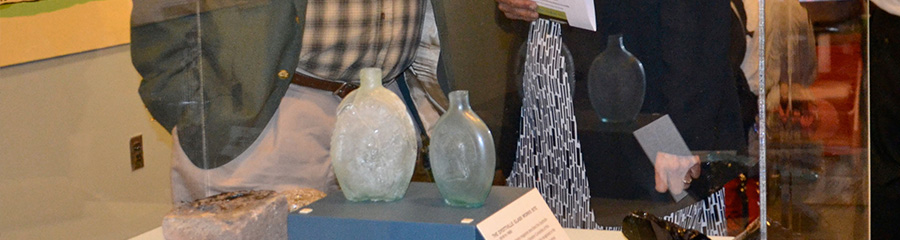
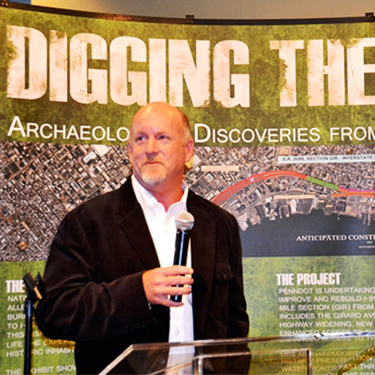
AECOM’s public display package can be developed to sustain a site’s history for generations and enable a local community to steward its own past as it prepares for a better future. Through the development of public-outreach products, site area’s recent and distant past can be brought to life through successive layers of exposition, from Internet sources, written documentation, photographs, museum exhibits, history lessons, and popular booklets. With the help of these materials, brought together in a coordinated public display, local citizens and visitors can journey through a site’s rich history in context and study its visual fabric. The display can consist of the material world of the past and include images and recordings. Such public displays can be mounted at a number of locations within project areas, including museums, schools, and libraries.
Services